Types of Hearing Aids Explained: Styles,...
May 06, 2026
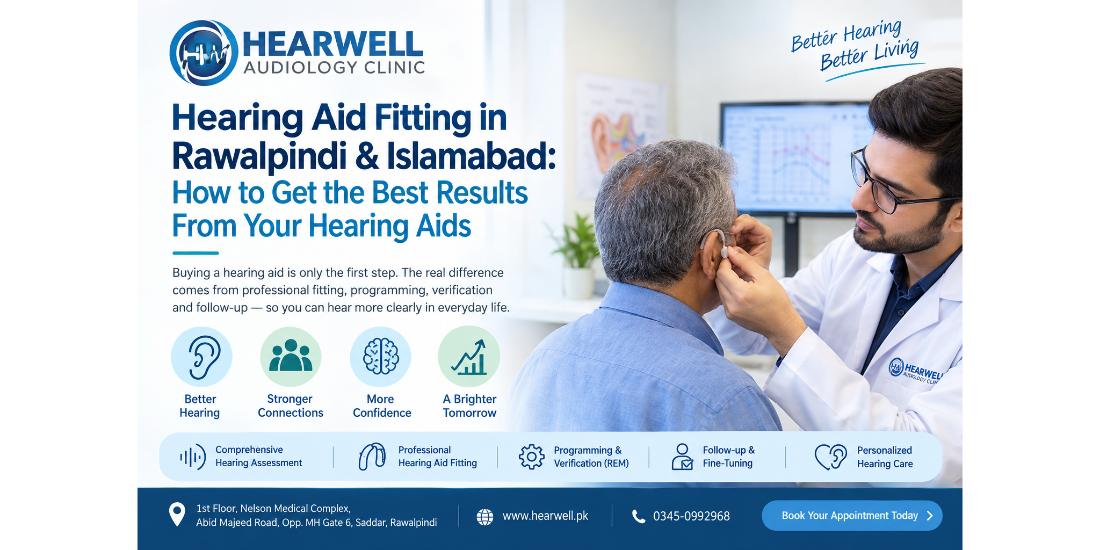
Buying a hearing aid is only the first step toward better hearing. The real difference often comes from what happens after you buy the device, how accurately it is fitted, programmed, verified, adjusted and supported over time.
A hearing aid is not simply a device that makes every sound louder. Modern hearing aids use sophisticated signal processing to provide different amounts of amplification at different frequencies and listening levels. The ideal settings depend on your hearing loss, ear anatomy, comfort, communication needs, lifestyle and everyday listening environments.
For this reason, professional hearing aid fitting and follow-up are important parts of hearing rehabilitation. Clinical hearing-aid management generally includes device selection, physical fitting, programming, verification, counseling, orientation and follow-up.
If you are looking for professional hearing aid fitting in Rawalpindi or Islamabad, understanding the fitting process can help you make a better decision about your hearing care.
What Is Hearing Aid Fitting?
Hearing aid fitting is the clinical process of adapting a hearing aid to an individual patient's hearing loss, ears, listening needs and preferences.
It is different from simply purchasing a hearing aid.
When you purchase a hearing aid, you are acquiring a device. During a professional fitting, the audiologist works with you to make that device function appropriately for your specific hearing requirements.
A comprehensive fitting may include:
Professional audiology guidance describes hearing-aid fitting as a multistep process involving both the patient and, when appropriate, communication partners or caregivers.
In other words:
Buying a hearing aid gives you the device. Professional fitting helps you get the intended benefit from it.
Why the Same Hearing Aid Can Sound Different for Different People?
Two people can use the same hearing-aid model and still describe its sound very differently.
This happens because hearing aids are not fitted according to the device model alone. Several individual factors influence hearing-aid performance and comfort.
Your Hearing Loss
Every hearing loss has its own configuration.
One person may have mainly high-frequency hearing loss, while another may have a flat or low-frequency hearing loss. The amount of amplification required at different frequencies therefore varies.
The fitting must account for the individual's audiogram and other clinical considerations rather than applying identical settings to every patient.
Your Ear Acoustics
The shape and acoustic characteristics of the ear canal influence the sound reaching the eardrum.
This is one reason objective verification methods such as Real Ear Measurement (REM) are valuable. REM measures the hearing aid's actual output in the patient's ear rather than assuming that the same settings will produce exactly the same acoustic result in every ear.
Receiver, Dome or Earmould Selection
The physical coupling between the hearing aid and ear also matters.
The audiologist may select different:
The appropriate choice depends on hearing loss, ear anatomy, feedback management, comfort, retention and acoustic requirements.
Loudness Tolerance
A hearing aid should provide sufficient amplification without making everyday sounds uncomfortably loud.
Some people adapt quickly to amplification, while others may initially find amplified sounds unusually loud or unfamiliar. The fitting can therefore require gradual adjustment according to the individual's comfort and rehabilitation needs.
Lifestyle and Communication Needs
Your ideal hearing-aid settings also depend on where you spend most of your time.
Someone who mainly communicates at home may have different priorities from someone who attends meetings, works in noisy environments, regularly watches television, participates in social gatherings or listens to music.
A modern fitting should therefore consider the person, not just the audiogram.
What Is Hearing Aid Programming?
Hearing aid programming is the process of adjusting the hearing aid's software-controlled parameters so that the device provides appropriate amplification and signal processing for the individual user.
Using manufacturer fitting software, an audiologist can adjust or configure parameters such as:
Amplification
The amount of amplification provided at different frequencies is adjusted according to the individual's hearing loss and fitting goals.
Compression
Compression controls how the hearing aid responds to different input levels. It helps provide appropriate amplification for softer sounds while preventing louder sounds from becoming excessively loud.
Noise Management
Modern hearing aids may incorporate different signal-processing features designed to improve listening comfort and manage unwanted environmental noise.
These features should be configured appropriately rather than simply being set to the maximum level.
Feedback Management
Acoustic feedback can produce whistling or other unwanted sounds.
Fitting, physical coupling and feedback-management systems can all play a role in reducing feedback.
Directionality and Environmental Processing
Many hearing aids modify their microphone and signal-processing behavior according to the acoustic environment.
The appropriate configuration depends on the individual device, hearing loss and listening priorities.
Hearing-Aid Programs
Some patients benefit from additional programs designed around particular listening situations.
For example, a fitting may include settings optimized for:
General speech → TV → noisy environments → music
The exact configuration should be individualized rather than automatically applying the same programs to everyone.
Professional audiology practice includes programming hearing aids using prescriptive targets, verification, modification and post-fitting management.
What Is Real Ear Measurement (REM)?
Real Ear Measurement (REM), also called probe microphone measurement, is an objective method used to verify how much sound a hearing aid is actually delivering in a patient's ear.
This is one of the most important concepts to understand when choosing professional hearing-aid care.
How Does REM Work?
A thin probe tube is carefully positioned in the ear canal close to the eardrum.
The hearing aid is placed normally on or in the ear, and calibrated sound signals are presented through a loudspeaker.
The REM system measures the acoustic output close to the patient's eardrum and allows the audiologist to compare the measured response with evidence-based prescriptive targets.
The hearing aid can then be adjusted to better match the desired targets for different input levels.
Why Is REM Important?
The same hearing-aid programming settings may not produce exactly the same acoustic result in every patient's ear.
REM accounts for individual ear-canal acoustics and provides objective information about the hearing aid's real-ear output.
ASHA describes REMs as the gold standard for hearing-aid fitting verification, with measurements used to verify that amplification is meeting prescriptive targets across frequencies and input levels.
REM can also help the audiologist evaluate factors related to:
This is why hearing-aid programming and hearing-aid verification are not necessarily the same thing.
Programming tells the hearing aid what to do.
Verification helps determine whether the hearing aid is actually doing what it should in your ear.
Why Your Hearing Aid May Still Sound Unclear?
It is possible to own a good-quality hearing aid and still experience problems with clarity or comfort.
That does not automatically mean that the hearing aid itself is defective.
Several factors can contribute.
Speech Sounds Muffled
Speech may sound muffled when amplification is not appropriately matched to the individual's hearing loss, when the physical coupling is unsuitable, or when further fine-tuning is needed.
Your Own Voice Sounds Strange
Some users experience an occlusion effect, where their own voice sounds unusually loud, boomy or different.
The acoustic coupling of the hearing aid, dome or earmould can contribute to this sensation. REM can also help the audiologist objectively assess and manage occlusion-related effects.
The Hearing Aid Sounds Too Loud
New hearing-aid users sometimes find amplified sounds louder than expected.
This may be related to acclimatization, programming, amplification levels or individual loudness tolerance. A professional fitting allows the settings to be reviewed rather than simply abandoning the device.
Background Noise Is Still Difficult
Hearing aids can improve access to speech, but listening in restaurants, markets and busy social environments remains challenging for many hearing-aid users.
Appropriate hearing-aid programming, microphone directionality, noise-management features, realistic expectations and communication strategies all have a role.
ASHA specifically notes that realistic counseling should recognize that amplification generally provides greater benefit in quiet than in noise.
Whistling or Feedback
Feedback may result from acoustic leakage, physical fit, insufficient retention, receiver/dome selection, earmould characteristics or other fitting factors.
It should be clinically assessed rather than simply tolerated.
Poor Physical Fit
A hearing aid should be comfortable and secure.
Issues with insertion, retention, pressure, earmould fit or receiver positioning can affect both comfort and acoustic performance. Physical fit is an established part of professional hearing-aid verification and fitting.
Incorrect Receiver, Dome or Earmould
The physical coupling is an important part of a hearing-aid fitting.
Changing the dome, receiver, earmould or venting may sometimes improve comfort, feedback control or acoustic performance.
Insufficient Acclimatization
Your brain needs time to adapt to amplified sound, particularly when you have lived with hearing loss for a long period.
A hearing aid should therefore not necessarily be judged after only a few hours of use.
Regular use and appropriate follow-up can help identify which sounds are improving and which settings still require adjustment.
Outdated Hearing Test
Hearing can change over time.
If your current hearing-aid programming is based on an old hearing test, the programmed amplification may no longer accurately reflect your present hearing levels.
A repeat hearing assessment may therefore be appropriate when there has been a significant change in hearing, communication ability or hearing-aid performance.
Hearing Aid Programming for Different Listening Situations
One of the advantages of modern digital hearing aids is their ability to process sound differently depending on the listening environment.
However, the best configuration should be based on the patient's real-world needs.
Conversation at Home
For one-to-one conversations in relatively quiet environments, the priority is generally comfortable and clear access to speech.
TV and Drama
Television can be challenging because music, special effects and dialogue may occur at different levels.
A hearing-aid program can sometimes be configured to make speech easier to follow while maintaining listening comfort.
Restaurants
Restaurants combine speech with multiple competing sound sources.
Patients may benefit from appropriate directional microphone and noise-management settings, combined with communication strategies such as positioning themselves closer to the person they want to hear.
Mosque
For many patients, listening in a mosque involves distance, reverberation and multiple speakers.
The appropriate hearing-aid strategy depends on the building, seating position, sound system and the user's hearing loss.
Meetings
Meetings can involve several speakers, changing speaker positions and background noise.
A suitable program and assistive connectivity features may help, depending on the hearing aid and environment.
Outdoor Environments
Wind and environmental sounds can affect hearing-aid comfort.
Modern hearing aids include processing designed for different acoustic situations, but settings should still be personalized to the individual.
Music
Music can require a different approach from speech.
Some hearing aids provide dedicated music programs or configurations designed to preserve musical sound characteristics. The appropriate settings depend on the user's preferences, hearing loss and type of music.
The goal is not to make every sound identical. The goal is to make important sounds more accessible and comfortable in the situations that matter to you.
How Often Should Hearing Aids Be Fine-Tuned?
Hearing-aid fitting should be viewed as an ongoing process, not a single programming appointment.
A patient may require adjustments after beginning regular use because real-world listening experiences can reveal problems that were not obvious during the initial fitting.
Fine-tuning may be appropriate when:
Post-fitting care can include confirmation of physical fit, validation of benefit, sound-quality assessment, programming adjustments, verification and device training.
This is why follow-up is an important part of hearing rehabilitation.
Hearing Aid Fitting vs Buying a Hearing Aid From an Online Seller
Online purchasing can make it easy to acquire a hearing device, but device acquisition and clinical hearing rehabilitation are different things.
Some categories of hearing devices can be purchased directly by consumers without an audiologist performing a fitting adjustment. For example, the U.S. FDA explains that OTC hearing aids may be purchased online without a medical exam, prescription or audiologist fitting adjustment.
A professionally managed hearing-aid pathway is different.
It may involve:
Hearing assessment → hearing-aid evaluation → device selection → physical fitting → programming → verification → counseling → follow-up → fine-tuning
The choice between purchasing a device independently and receiving professional hearing-aid management should therefore consider more than the initial purchase price.
The important question is:
“What level of clinical support will I receive after purchasing the hearing aid?”
For many patients, appropriate fitting, verification, counseling and follow-up are essential components of achieving satisfactory hearing-aid outcomes.
How Much Does Professional Hearing Aid Fitting Cost in Pakistan?
The cost of hearing-aid services in Pakistan can vary depending on the clinic, the type of service, whether a hearing aid is being purchased, the complexity of the fitting and the level of follow-up provided.
It is therefore useful to distinguish between hearing-aid device price and professional hearing-aid fitting and rehabilitation services.
When comparing hearing-aid prices, ask what is included in the package.
For example:
At HearWell Audiology Clinic, hearing-aid care is approached as a clinical rehabilitation process rather than simply a product transaction. The appropriate hearing aid and fitting approach are selected according to the patient's hearing loss, communication requirements and listening lifestyle.
For current hearing-aid prices and fitting-service details, patients should contact HearWell Audiology Clinic for an individualized recommendation.
Where to Get Professional Hearing Aid Fitting in Rawalpindi & Islamabad
If you are searching for hearing aid fitting in Rawalpindi, hearing aid programming in Islamabad, hearing aid adjustment, REM hearing aid fitting, or professional hearing-care services, choosing an audiology clinic with appropriate assessment, fitting, verification and follow-up facilities can make an important difference.
HearWell Audiology Clinic provides professional hearing care for adults and children, including hearing assessment, hearing-aid selection and fitting, programming, verification, counseling, follow-up and hearing rehabilitation.
The clinic is located at:
1st Floor, Nelson Medical Complex, Abid Majeed Road, Opp. MH Gate 6, Saddar, Rawalpindi
For appointments and hearing-aid consultation:
Website: www.hearwell.pk
Contact: 0345-0992968
Whether you are buying your first hearing aid, experiencing problems with an existing device, or looking for professional hearing-aid programming and fine-tuning, an individualized clinical assessment is the appropriate starting point.
Take the Next Step Toward Better Hearing
A hearing aid is only as useful as its real-world performance.
Proper hearing assessment, personalized fitting, programming, verification, counseling and follow-up can help you get the most appropriate benefit from your hearing technology.
At HearWell Audiology Clinic, our approach is centered on personalized hearing care and evidence-based hearing-aid fitting for patients in Rawalpindi, Islamabad and surrounding areas.
Do not choose a hearing aid based on price or technology alone. Choose a hearing solution that is properly matched, professionally fitted and supported over time.


Comments (0)
Leave a Comment
No comments yet. Be the first to comment!